
Mature people analytics teams can answer any 'what' question but go silent on 'why.' The winners in HR's AI era will build a context layer, not just chase better models.
Why HR needs a context layer to win the next wave of AI
The teams that will get real value from AI in HR are not the ones with the best model access. They are the ones who have built a context layer: a structured, queryable store of the organizational knowledge that their transactional systems were never designed to hold.
If you run a mature people analytics function, you already sense the ceiling. You have the warehouse, the semantic models, the dashboards, the roadmap. You can answer almost any "what" question in the business. Attrition by cohort, span of control by function, time-to-fill by requisition type. And yet when leadership asks why the last three transformation efforts stalled, or whether the org is actually ready for a $20M HCM investment, your instruments go quiet. That gap is not a data volume problem. It is an architecture problem. You are missing a layer.
What is a context layer, and why doesn't HR have one?
A context layer is the structured body of grounding knowledge an AI system retrieves from before it reasons or generates. In modern AI architecture, the model is the reasoning engine; the context layer is what keeps that reasoning tied to your reality instead of the internet's average.
Context layer: The structured, retrievable store of organizational knowledge, both quantitative and tacit, that grounds AI outputs in the specific truth of your enterprise rather than generic patterns.
Most HR functions have never built one because their entire data architecture is transactional. Your HCM, your ATS, your case management system, and the warehouse sitting downstream of them all capture events: a hire, a transfer, a comp change, a survey response coded to a five-point scale. This is the "what." It is clean, it is countable, and it is exactly what your BI layer was engineered to serve.
The "why" lives somewhere else entirely. It lives in the reasoning of the HR business partner who knows the real reason the reorg failed. It lives in the process exceptions that never made it into a system of record. It lives in the difference between what the org chart says and how work actually moves. That knowledge is tacit, unstructured, and, in most enterprises, undocumented. When you point a large language model at your data warehouse, you get eloquent summaries of the "what" and confident hallucinations about the "why." The model has no context layer to retrieve the "why" from, so it invents one.
Why won't better models close the gap?

HR's next wave of AI will be won by those who build the critical context layer, not just by access to better models.
Better models will not close the gap because the constraint is retrieval, not reasoning. Frontier lab AI models lack access to your organization's specific, grounded context at the moment of generation. Give the same model a rich, structured knowledge store, and the output quality changes categorically.
This is the lesson the broader AI engineering community has already absorbed. The architectural pattern that separates useful enterprise AI from demos is retrieval-augmented generation: the practice of grounding a model's output in a curated knowledge store rather than its training data alone. AWS defines retrieval-augmented generation as the process of optimizing model output so it references an authoritative knowledge base outside its training sources before generating a response. The entire value of that pattern collapses if the knowledge base does not exist. For HR, it mostly does not.
So the sequence matters. Investing in AI copilots and generative HR tooling before you have a context layer is like installing a high-performance query engine on top of an empty database. The tooling works. It has nothing true to say.
How do you actually build one for HR?
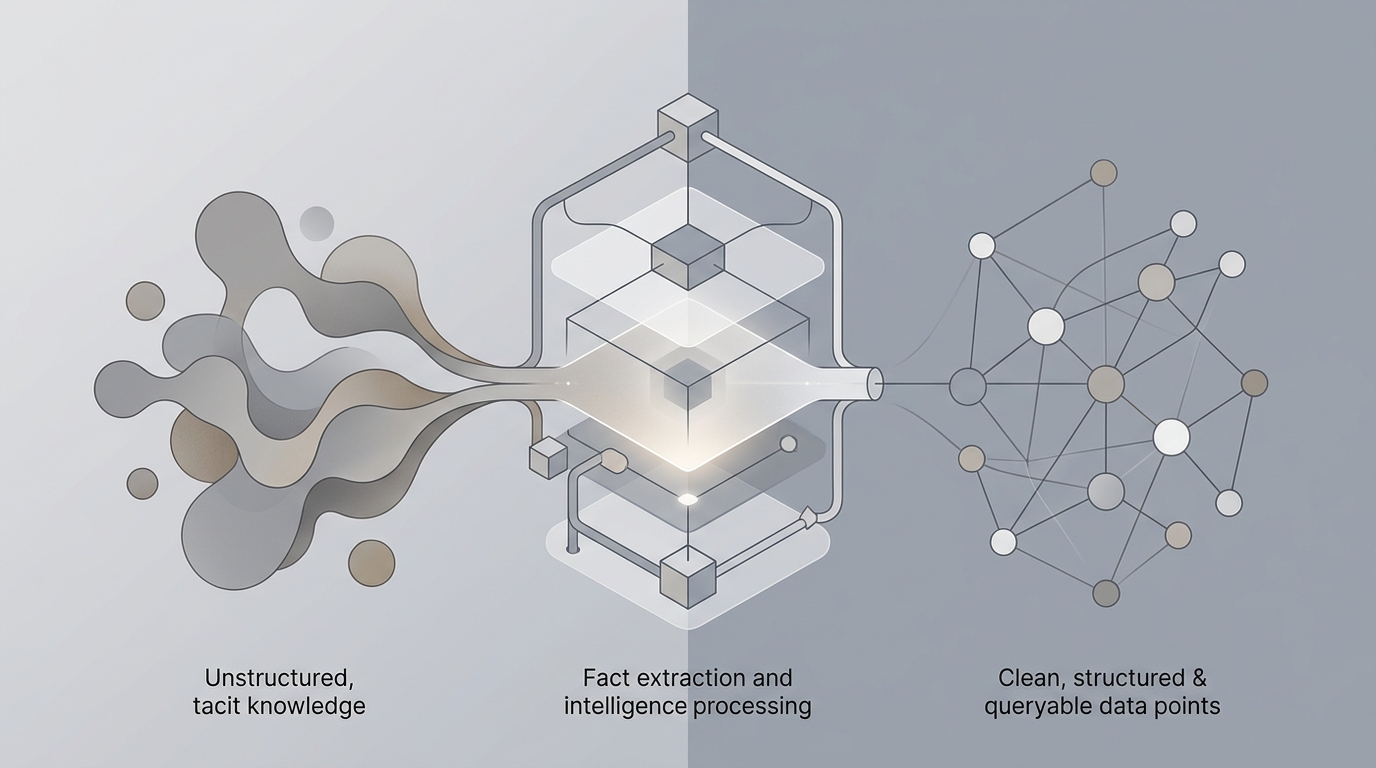
Ikona Analytics' intelligence refinery transforms raw, tacit organizational knowledge into structured, queryable facts, making it actionable for advanced AI applications.
You build an HR context layer by capturing tacit knowledge at scale, refining it into structured facts, and storing it in a form both humans and machines can query. This is the core of what we do at Ikona Analytics, and the architecture is deliberately unglamorous.
Capture comes first. In a full Ikona Systems Diagnostic (ISD), we run 44 to 64 structured interviews across the HR organization, generating 1,700+ pages of qualitative data. This is not a survey. Surveys pre-code the answer space and discard everything interesting. A structured interview, with a custom instrument built for each participant, captures the reasoning, the exceptions, and the connective tissue that transactional systems never see.
Structure comes next. Raw interview data is useless to a retrieval system until it is refined. We process every interview through a five-layer intelligence refinery: raw, transcribed, cleaned, fact-extracted, anonymized. Fact extraction is the load-bearing step. It converts narrative into discrete, attributable, queryable assertions that an AI system can retrieve against with precision, without dragging along the noise and PII that make most qualitative data un-shippable.
Activation is where the context layer earns its cost. Once the knowledge store exists, you generate outputs from it: business cases, process maps, transformation roadmaps, governance models, AI readiness assessments. Because the output is grounded in your organization's actual facts, it is defensible in front of a CFO in a way a template never is.
Before you fund another AI copilot for HR, ask: what structured, queryable body of organizational context will it retrieve from, and who owns it?
On-going Curation is the next phase. You can run a context layer as a one-time project to solve short-term goals, but the real value of this layer comes from on-going curation and expansion of the layer. Process, tooling, and mechanisms need to be in place to refresh and make the context layer evergreen and self-healing.
(And if you'd like to learn more about how Ikona is approaching on-going curation for our clients, reach out and we'd be happy to give a preview of our roadmap).
What makes a context layer worth the investment?
A context layer is worth the investment because it compounds. Unlike a consulting deliverable that depreciates the moment it is presented, a knowledge store persists and accrues value. Six months after an engagement, clients are still activating new intelligence modules against the same knowledge base, answering questions that were never in the original scope, without re-interviewing anyone.
The economics are concrete. In one engagement, a client needed a business case for a $15M to $25M HR tech investment. Working from the knowledge store built during 60 interviews, we produced the CFO-grade report in about an hour. The client estimated a traditional consulting team would have charged $100,000 for the same output. The difference was not speed of typing. It was that the context layer already existed, structured and queryable, waiting to be activated.
That is the strategic point for a mature PA leader. Your dashboards answer today's question and reset tomorrow. A context layer answers today's question and gets cheaper and faster at answering every question after it. The second engagement starts faster, goes further, and costs a fraction of the first, because the layer is already there.
The next wave of AI in HR will not be won by the function with the most sophisticated model or the largest vendor contract. It will be won by the function that built the layer of grounded organizational context those models need to be useful. Most HR organizations are about to spend heavily on the reasoning engine while ignoring the retrieval problem underneath it. That is the diagnostic gap worth closing first.
Frequently asked questions
Discover how a structured context layer can unlock unprecedented value for HR in the next era of AI, beyond transactional data.
Q: Is a context layer the same as a data warehouse or lakehouse?
No. A warehouse stores structured, transactional and largely quantitative data optimized for the "what." A context layer stores structured tacit knowledge, the reasoning and process reality behind the numbers, optimized for grounding AI reasoning about the "why." They are complementary, not substitutes.
Q: Can't we just point an LLM at our existing HR data?
You can, but it will summarize your transactional "what" well and fabricate the "why," because your systems never captured the tacit context. Without a grounding knowledge store, retrieval-augmented generation has nothing authoritative to retrieve from.
Q: How long does it take to build an HR context layer?
Ikona's full ISD delivers a diagnostic and structured knowledge store in under 90 days, drawing on 44 to 64 interviews. ISD Lite is a four-week, roughly 20-interview engagement focused on a single domain, often used as a proof of concept.
Q: Who can access the knowledge store after the engagement?
The client continues to receive access. It persists as a durable knowledge asset and can be activated for new intelligence modules months later without re-interviewing the organization. It does not walk out the door when the consulting engagement ends.
Sources
Amazon Web Services, "What is Retrieval-Augmented Generation (RAG)?" https://aws.amazon.com/what-is/retrieval-augmented-generation/
Written by
Ikona Analytics
Ikona Analytics is a workforce intelligence consultancy that helps enterprises build people analytics functions that scale. This piece reflects the collective perspective of the Ikona team.
Learn more about our team