
HR keeps getting pulled into operations not because of a competence problem, but a design problem. Here's the operating model that finally resolves the tension.
Stop bolting AI onto HR. Redesign where the work happens.
One question keeps coming up in conversations with CHROs, and it is not really about AI, even though it sounds like it. The board wants to know what AI means for the workforce. The CEO wants a point of view on AI and workforce planning. A business leader is asking, with varying patience, why HR is not leading the conversation on the workforce.
Underneath that question sits something older and more structural: why does the function keep getting pulled back into operations when everyone inside it is trying to move toward strategy? The honest answer reframes the job.
HR is a regulatory control function, and the CHRO's real mandate is not to run a department of people. It is to own the workforce operating system, the whole architecture that decides where the variability of a workforce gets absorbed. Once you see the function that way, the AI question answers itself, and so does the operating-model question that has dogged HR for 20 years.
Why HR keeps getting pulled back into operations
The pull is real, and it is measurable. Gartner reports that 83% of HR leaders say they are expected to do more today than they were three years ago [1]. A separate Gartner survey found that fewer than two in five HR leaders believe their function even separates transactional work from strategic work appropriately, and that leaders want more strategic time but the operating model will not give it to them [2].The pattern is consistent across years of research: HR ranks strategy highest and spends its days on execution.
The usual explanations (HR lacks the right skills, data, credibility, or seat) carry some hard truths and still miss the deeper problem. The function is structurally overloaded because too much workforce variability has nowhere to go except a person in HR.
For most of the function's history, HR work and HR workers were nearly the same thing. If a manager needed coaching, an HR business partner (HRBP) did it. If an employee had a question, a generalist answered it. If a pay decision needed review, a compensation analyst checked it. The human became the universal routing layer for workforce management. Given the nature of working with other people, a human answering the question was the only mechanism flexible enough to handle the variability of people in systems.
That structural reality, not a failure of ambition, is the primary reason HR has struggled to become strategic. And it is worth being precise about what that means: this is not a competence or motivation problem. It is a design problem. The work is not landing on people because those people are doing their jobs badly. It is landing on them because no other part of the system was built to catch it. The distinction matters, because design problems are fixable in a way that competence problems are not.
The system is also serving a purpose. We as HR are not avoiding strategic work and doing administrative work we could simply stop. Work is required by the business and flows to a place where it can be completed, and the flow has to go somewhere. Employee and Manager self-service was an attempt to redirect it, but it did not remove the work; it pushed the work onto employees and managers whose plates were already full.
Across our engagements, we see this in the data before anyone names it. A core part of the Ikona Analytics engagement is conducting structured interviews across an HR organization using our Ikona Systems Diagnostic (ISD) methodology, and a consistent finding emerges. HR professionals can describe, in detail, the strategic work they should be doing. They can describe, in equal detail, the operational gravity that prevents it. The gap between those two descriptions is the most productive place to begin a transformation.
Diagnostic question. If you mapped every type of work your HR team performed last month, what percentage was absorbed by a human only because no system, workflow, or control existed to handle it at a lower layer?
So where does that administrative work actually come from, and is it permanently grafted onto the HR worker's plate, or can it be routed somewhere it can be resolved? The answer comes from systems thinking, and from recasting the function as something larger than the people who staff it.
HR as regulatory control: the reframe that changes the operating model

Stop bolting AI onto old HR models. The future of HR is about fundamentally redesigning where work happens across a multi-layered workforce operating system.
Here is the core of it. HR does not exist simply because organizations have people. HR exists because organizations need to regulate the variability of people working in systems.
That may sound clinical, but I'm using these terms very specifically. Lean on these definitions for the rest of the piece.
Regulate. To hold a system inside an intended range as conditions change. Regulation is not control in the absolute sense. A regulator does not dictate every state; it corrects toward a target when the system drifts.
Variability. The full range of states a system could produce. It is potential, not yet realized: every different call two managers might make, every different norm two teams might form, before anything has actually happened.
Variance. The realized gap between what the organization intended and what the workforce actually produced. Variability is the spread of what could happen; variance is the specific deviation that someone now has to absorb. Named honestly, the entire function exists to absorb variance.
Systems. The interacting parts, people, processes, technology, incentives, and information, whose combined behavior produces outcomes that no single part controls. A system is the reason a sound policy still yields inconsistent decisions: the output belongs to the whole, not to any one input.
Regulatory control. Any mechanism that keeps a system inside its intended range. A thermostat is a regulatory control on temperature. A compensation band is a regulatory control on pay. Most of what HR does, described plainly, is regulatory control over the behavior of a workforce.
Requisite control. The right amount of control, no less and no more. It follows from Ashby's law (below): a regulator can only absorb the variety it has the internal variety to match. Too little lets intolerable variance through; too much adds friction and stops the system moving. The target is sufficiency, not maximum.
The principle behind requisite control comes from W. Ross Ashby, a British psychiatrist and one of the founders of cybernetics, the study of regulation and control in systems. In his 1956 book An Introduction to Cybernetics, Ashby set out what became known as the Law of Requisite Variety: for a system to stay stable, its regulator must command at least as much variety as the disturbances it has to handle. The shorthand most people know is "only variety can absorb variety."[3] Put plainly for our purposes, you can only regulate the range of situations you are actually built to meet. A regulator with too few responses gets overwhelmed by a world with too many.
Stafford Beer, a British cybernetician who built directly on Ashby's ideas, carried this into organizations. Beer is regarded as the founder of management cybernetics, and his Viable System Model, set out across Brain of the Firm and The Heart of Enterprise, made a claim that sits underneath this entire piece: any organization that survives in a complex environment is, in effect, a control system, with parts that sense the state of the business and parts that act to keep it in range [4]. HR is one of those parts.
I started my career in HR as an HRBP and anyone who has worked as an HRBP has lived it. We sense what is happening across the organization, and we intervene to keep it moving. The work has not historically been named that way, and it is not the most glamorous description of it, but it is an unusually clear lens on where the function is headed. For a current and readable treatment of the same tradition, Dan Davies's The Unaccountability Machine is the best recent guide, and his idea of an "accountability sink," a place in a system where responsibility quietly drains and pools, is a precise description of what HR has had to become in many organizations [5].
Look at what this produces in practice. Two managers read the same policy and make different calls. Two teams receive the same strategy and build different norms. Two leaders inherit similar organizations and create entirely different conditions. The organization intends one thing. The workforce produces another. HR lives in the gap.
The organization intends one thing. The workforce produces another. HR lives in the gap.
Compensation philosophy exists because without it, managers facing similar situations make inconsistent pay decisions. Performance management exists because standards drift and promotion decisions become indefensible. Onboarding exists because the first 90 days should not depend on whether a new hire happened to land under a good manager. The evidence backs the design. SHRM's research finds that employees who go through strong, structured onboarding are far more likely to still be with the company three years later, while unstructured onboarding leaves the outcome to chance [6].
When you see HR as a regulatory control function over the internal systems of a company, the operating-model question changes. You stop asking "how do I organize the HR department," and start asking "how do I design the workforce operating system, and where in it should each kind of variance be absorbed?"
The six layers of workforce regulation
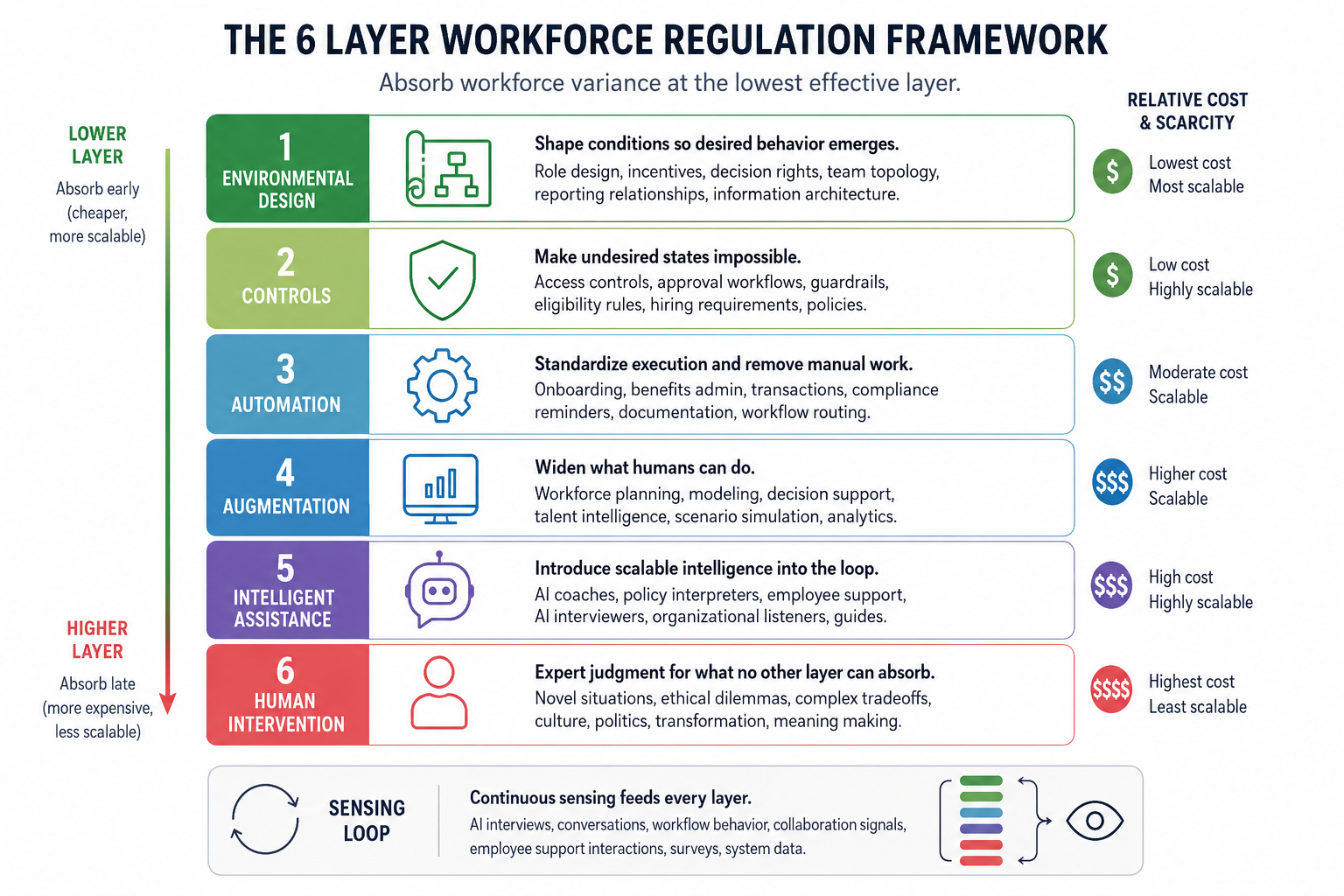
The six-layered workforce regulation stack reveals that absorbing variance at the lowest effective layer is key to efficiency and scalability, reserving human judgment for truly complex problems.
If HR is a regulatory control function, the operating-model question becomes concrete: where, exactly, does workforce variance get absorbed, and at what cost?
Across enterprise HR organizations, six distinct layers consistently emerge. Each one absorbs variance differently, at a different cost, scale, and degree of context-dependence. Together they form a stack, and the position of a given problem in the stack determines what kind of intervention it actually needs. One principle holds the whole thing together, and it is worth stating before the layers themselves: absorb workforce variance at the lowest effective layer. The lower the layer, the cheaper, more scalable, and more consistent the regulation. The higher the layer, the more expensive, scarce, and context-dependent the mechanism.
Layer 1: Environmental design
Environmental design absorbs variance before it forms. Role design, incentive structures, decision rights, team topology, reporting relationships, and information architecture shape behavior at the level of conditions rather than enforcement. A well-designed role carries enough authority for work to happen without escalation. A well-designed incentive aligns individual interest with collective outcome. A well-designed structure makes the desired behavior the easiest path.
This is the most consequential layer in the stack, and at the point of intervention the cheapest. Nothing has to be enforced. Nobody has to be coached. The behavior emerges from the conditions. It is also the layer most organizations underinvest in, because success here is invisible. There is no ribbon cutting for a structure that prevents a problem from forming, and no dashboard celebrating the escalation that never happened. One of the hardest truths of this work is that the highest leverage in the function lives at the one layer almost nobody is rewarded for working on.
Layer 2: Controls
Controls absorb variance by making certain states impossible. Access controls, permission systems, approval workflows, compensation guardrails, hiring requirements, eligibility rules, and security policies all work the same way: they remove options. The undesired action cannot occur, so no coaching is required and no intervention is needed. The variance is foreclosed in advance.
If your compensation system cannot produce a pay decision outside a defined band without an exception workflow, you do not need a separate process to catch that form of pay inequity after the fact. The control already caught it. If your hiring system enforces structured interviews and required scorecards, you do not need a downstream calibration meeting to clean up unstructured judgment. The control absorbed that variance upstream.
The discipline here is calibration. Too little control produces chaos; too much produces bureaucracy. The goal is not maximum control. It is requisite control: enough structure to absorb the variance the organization cannot tolerate, and not so much that the system stops moving.
Layers 3 through 6 are not four separate ideas. They are one gradient. Read from the bottom up, each layer hands a little more of the work back to a human and keeps a little less inside the machine. Automation is almost entirely machine. Human intervention is almost entirely person. Augmentation and assistance are the two steps in between, and the line between them is the most useful distinction in the whole stack: in augmentation the system does the work and a human decides; in assistance a human does the work and the system guides. Hold that line. It is where most of the confusion about AI in HR lives.
Layer 3: Automation
Automation absorbs variance by standardizing execution. Onboarding workflows, benefits administration, employee transactions, status changes, compliance reminders, documentation, and workflow routing all share one property: the machine performs the whole action, the same way every time, and no human has to be in the loop for it to complete. The action still happens. The human time required to make it happen approaches zero, and the variance in how it gets done approaches zero with it.
Most HR technology investment of the last 20 years has lived here. It is well understood, and in most large organizations it is nowhere near finished. The function still has significant human labor sitting inside work that is not human work: people chasing approvals, people moving data between systems, people answering the same question for the hundredth time this quarter, people operating processes that should no longer require operators. That is not human-centered work. It is human time used as glue. Automation removes the glue.
Layer 4: Augmentation
Augmentation absorbs variance by widening what a human can do. Here, for the first time in the stack, the machine's share of the work drops and the human's share rises. Workforce planning tools, organizational modeling, talent intelligence, scenario simulation, compensation modeling, and review drafting all follow the same logic: the system does substantial work on the human's behalf and produces something, a model, a draft, a ranked set of options, and the human directs the system and decides what to do with the output. The human stays in the loop, not to operate the process, but to govern it.
A planner who can model ten scenarios in an afternoon is doing different work than one who can model two in a week. A leader who can see the organizational consequences of a decision before making it is in a different decision environment than one who waits three weeks for the analysis. An HRBP who can pull a coherent picture of attrition risk on a team in five minutes is having a different conversation with that team's leader than one who first has to schedule time with people analytics.
This is the layer the profession has been promised for a decade, and part of the promise has been delivered. The larger gains are still ahead, because the earlier generation of tools was limited by the variety it could handle. It could calculate, report, model, and visualize. It could not interpret context with much flexibility. That is the constraint now lifting, and it is what makes the next layer possible at all.
Layer 5: Assistance
Assistance absorbs variance by guiding a human through an action the human still performs. This is the fuzzy neighbor of augmentation, and the difference is worth stating precisely: augmentation does the work and hands it to a person to approve; assistance hands a person the judgment they need while they do the work themselves. The system does not act. It informs the act. A manager runs a difficult conversation; an assistant coaches them through it. An employee weighs a career move; an assistant helps them reason it out. A practitioner interprets an ambiguous policy; an assistant surfaces the rule, the precedent, and the edge cases at the moment of the decision. The human's hands are on the work. The system sits beside them.
This layer barely existed in a serious form until recently, and the reason is Ashby. Guidance only helps if it fits the situation, and a regulator can only meet a situation it has the variety to match. The old reference tools had almost none. A policy portal returned the same article to every query. A manager toolkit offered the same five tips to every manager. They could store an answer; they could not read a situation. What has changed is that a non-human source of guidance finally has enough variety to engage an individual case: this manager, this team, this conversation, this constraint. Situational judgment can now be offered to a person at the moment they need it, without a more senior person having to be the one to offer it.
The economic consequence is the part the profession has under-discussed. The best developmental guidance has always been scarce, because it was bottlenecked on senior human attention. Executive coaching went to executives. High-touch career guidance went to selected populations. Real-time policy interpretation went to whoever could get an HRBP on the phone. When situational guidance stops being a function of headcount, the boundary of who can be helped moves all the way out to everyone. This does not make human guidance irrelevant. It makes human guidance something you allocate deliberately, to the cases that have earned it, rather than ration by accident, to whoever happened to ask.
Layer 6: Human intervention
Human intervention is where the machine's share reaches zero and the work runs entirely on human judgment. It is also where everything lands that the layers below could not absorb. At its best, this is genuinely human work on genuinely human problems: novel circumstances, ethical dilemmas, ambiguous tradeoffs, cultural interpretation, organizational politics, executive advisory, transformation leadership, meaning-making. At its worst, it is the residue of the layers that failed: the onboarding step nobody automated, the job architecture nobody had time to design properly, the PTO balance answered by Slack for the hundredth time today.
Human intervention was the historic starting point for the entire function. It should become the exception-handling layer of the workforce operating system. By the time a situation reaches it, every lower layer has either failed to absorb the variance or correctly judged that the variance requires a kind of judgment only a senior practitioner can supply. This is the high-value work the profession has spent decades saying it wanted, and strategy requires capacity, which is exactly what the lower layers create. As they mature, the human layer finally gets the room to be human.
The principle, and the sensing loop that completes the system
The future of HR isn't just about AI; it's about fundamentally redesigning where workforce variability is absorbed across the enterprise.
You have already met the principle that holds the stack together: absorb workforce variance at the lowest effective layer. Human judgment is the most powerful regulator in the stack and the least scalable. Reserve it for the work that truly requires it.
But the six layers, on their own, are not yet a control system. They are a hierarchy of interventions. What makes them a control system is sensing, because no regulator can act without information about the state of the thing it regulates.
Workforce sensing has historically been primitive. Annual surveys, periodic pulses, focus groups, manager anecdotes, exit interviews. The cadence is slow, the sample is thin, the interpretation is manual. By the time a signal is visible, the variance has often already produced the outcome the system was trying to prevent. It is the organizational equivalent of steering a ship by watching where it was an hour ago.
The emerging model is continuous sensing. AI interviews at scale, conversational systems, knowledge interactions, workflow behavior, collaboration signals, employee support conversations, manager coaching exchanges. The workforce becomes observable in something close to real time. The control loop shortens. Interventions move earlier. Variance becomes visible while it can still be designed around, rather than after it has hardened into a crisis. Sensing feeds every layer with information about the state of the system, and the layers adapt.
That is the architecture. Six layers absorbing variance, wired together by a sensing system that closes the loop. Not the HRIS. Not the talent platform. The whole regulatory system is the real underpinning of HR.
Where AI fits: an accelerant on every layer, not a layer of its own

AI's true power lies not in being a separate HR function, but in its ability to accelerate variance absorption and enhance capabilities across every layer of the workforce operating system.
There is a tempting mistake hidden in this stack, and it is worth naming before anyone acts on the model. The mistake is to treat AI as a seventh layer, a new step you bolt onto the top and call your AI strategy. AI is not a layer. It runs vertically through all six, and it changes the economics of each one differently. That is the real value of the stack for a leader deciding where to start: it turns one overwhelming question, "what do we do about AI," into six concrete and much smaller ones.
On environmental design, AI makes the cheapest layer designable. Structure, roles, incentives, and decision rights have always been the highest-leverage place to absorb variance and the hardest to get right, because you could not see the consequences of a design until you shipped it and lived with it. AI lets you model a reorganization, a new role boundary, or an incentive change and simulate its likely downstream behavior before you commit. The layer that prevents problems from forming becomes something you can reason about, rather than something you discover you got wrong a year later.
On controls, AI turns static rules into adaptive ones. A control used to be a fixed gate: it caught the states it was written to catch and was blind to the rest. AI can watch the system continuously for drift, flag the out-of-range state nobody wrote a rule for, and surface where a guardrail is missing before the variance it would have caught becomes an incident. The discipline is still calibration, requisite control rather than maximum control, but the calibration can now be continuous instead of annual.
On automation, AI reaches the work that rules could never touch. Classic automation handled the structured, predictable transactions and left everything ambiguous to a person. That ambiguous remainder, the exception, the unusual case, the request that did not fit the form, is exactly where human time has always pooled. AI extends execution into that remainder, absorbing the messy fraction of transactional work that defeated every workflow engine before it.
On augmentation, AI is the engine. This is the constraint from the augmentation section lifting in practice. The model that took an analyst a week, the first draft that took an HRBP an afternoon, the option set that required a meeting with people analytics to assemble: AI produces them in the time it takes to ask. The human still directs and decides. The cost and latency of producing the thing to decide on falls toward zero.
On assistance, AI is the whole point. No prior technology has had the variety to give a specific person situational guidance about a specific problem. This is the layer AI does not merely accelerate but creates, and it holds the largest unclaimed economic ground in the function, because guidance was always rationed by the supply of senior attention and never has to be again.
On human intervention, AI's contribution is subtraction. Its job at the top of the stack is to not be there. Every unit of variance it absorbs in the five layers below is a unit that never reaches a senior practitioner, and that is the only mechanism that has ever actually freed the human layer to do the strategic work the function keeps promising itself. Where a person is genuinely required, AI supports them the way it supports any expert: synthesis, preparation, a fast first pass, never the judgment itself.
Read this way, an AI pilot stops being a technology decision and becomes a targeting decision. You are not asking whether to adopt AI. You are asking which layer in your organization is absorbing variance most expensively right now, and what AI would do if you pointed it there. A function drowning in transactional exceptions has a layer-3 problem and should pilot there. A function whose managers make wildly inconsistent calls has a layer-1 or layer-2 problem, and an AI coach bolted onto layer 5 will treat the symptom while the cause keeps generating it. The stack tells you not just that AI can help, but where it will pay, and where it will only paper over a design failure one layer down.
Diagnostic question. Across your function right now, which single layer is absorbing the most expensive variance, and is your current AI thinking aimed at that layer, or at the one that is easiest to buy a tool for?
That targeting question is, in practice, the hardest one to answer from the inside, because the most expensive variance is usually the most normalized.
What the CHRO actually owns next
The strategic CHRO is not the leader of a department of humans, and not a department of humans plus agents. They are the architect of this end-to-end six-layer system, accountable for how the organization senses, interprets, and shapes workforce outcomes across people, process, technology, data, and AI. That is a concrete ownership shift. Today, most CHROs own the HR function. Tomorrow, the most effective ones will own the design logic of where workforce variance is absorbed across the enterprise.
This is not an abstract distinction. The organization that redesigns where its workforce variance is absorbed will run HR at a structurally lower cost and a structurally higher strategic capacity than the one that keeps routing every exception to a person. That gap compounds. It is the kind of advantage a board should care about, and the kind a competitor will not announce.
The HRBP role shifts with it. The HRBP of the future is not primarily a relationship manager. They are a variance specialist, the tip of the spear, forward-deployed to read the gap between intended workforce outcomes and observed reality and to decide where in the stack each intervention belongs. Sometimes the answer is a conversation. Sometimes it is a structural redesign, a tighter control, a smarter workflow, an intelligent agent in the flow of work, or the senior practitioner you have been trying to free up for two years. The skill is not pulling every problem into the human layer by default. The skill is knowing where each kind of variance actually belongs.
Diagnostic question. For your three most common HR escalations this quarter, could the underlying variance have been absorbed earlier, through better environmental design, a tighter control, a smarter workflow, or an intelligent agent in the flow of work?
Here is the honest friction. This reframe is hard to sell internally, because it asks HR leaders to acknowledge that much of the function's current activity is compensating for system-design choices rather than doing work that was ever truly required. The operational load is only mandatory if the system was never designed with intention. That admission is uncomfortable, and it is also the starting point for any real transformation. To say it once more: it is not an indictment of the people. It is an indictment of the design, and the design is the thing a CHRO can change.
If you want to test the model against your own organization, there is a 30-minute version. Take your HR team's work from the last month, or just this quarter's escalations, and sort each item into one of the six layers by asking where it could have been absorbed. The cluster you find is your operating model, drawn from reality rather than from the org chart. The layer where the work piles up is the layer your AI strategy should be aimed at first.
Back to the AI question
Answered properly, the AI question was a workforce-architecture question all along. AI does not simply make HR teams more productive. It lets more of the workforce operating system absorb work that previously had nowhere to go but a person in HR. McKinsey has argued that building the organization of the future requires CHROs to reimagine the operating model itself, not just staff it differently [7]. Gartner's current read goes further still: HR is now being forced to evolve its operating model specifically in response to AI [8]. The organizations that understand this will not bolt AI onto the old department. They will redesign where the work happens.
If you are not certain where your workforce variance is actually being absorbed, that is the deep question our ISD diagnostic answers. In a matter of weeks, not quarters, it shows you where in the stack your organization absorbs variance today, what it is costing, and which layer would repay an intervention first. That is the map you need before you spend another dollar on AI and to escape the operational pull of a misaligned intervention stack.
Liked what you read? Subscribe to our bi-weekly digest for more practitioner perspectives.
Sources
[1] Gartner, "Gartner Survey Finds 83% of HR Leaders Are Expected to Do More Now Compared to Three Years Ago" (2023). https://www.gartner.com/en/newsroom/press-releases/2023-10-23-gartner-rhr-keynote-unlocking-human-performance
[2] Gartner, HR structure survey reported in "Gartner Survey Shows 63% of HR Leaders Are Taking Steps to Be More Agile" (2020). https://www.gartner.com/en/newsroom/press-releases/2020-07-23-gartner-survey-shows-63-percent-of-hr-leaders-are-taking-steps-to-be-more-agile
[3] W. Ross Ashby, An Introduction to Cybernetics (1956); the Law of Requisite Variety. Overview: https://www.edge.org/response-detail/27150
[4] Stafford Beer, Brain of the Firm (1972) and The Heart of Enterprise (1979); the Viable System Model. Overview: https://en.wikipedia.org/wiki/Viable_system_model
[5] Dan Davies, The Unaccountability Machine: Why Big Systems Make Terrible Decisions, and How the World Lost Its Mind (2024).
[6] SHRM, "Don't Underestimate the Importance of Good Onboarding." https://www.shrm.org/topics-tools/news/talent-acquisition/dont-underestimate-importance-good-onboarding
[7] McKinsey & Company, "The New Possible: How HR Can Help Build the Organization of the Future" (2021). https://www.mckinsey.com/capabilities/people-and-organizational-performance/our-insights/the-new-possible-how-hr-can-help-build-the-organization-of-the-future
[8] Gartner, "Top Priorities for HR Leaders" (2026 HR trends). https://www.gartner.com/en/human-resources/trends/top-priorities-for-hr-leaders
Written by
Richard Rosenow
Richard Rosenow is Co-Founder and Chief Product Officer of Ikona Analytics, where he owns the ISD (Ikona Systems Diagnostic) methodology, client delivery, and product. He started as an HR business partner at Citi and spent 15 years in People Analytics at GE, Meta, Uber, Nike, and Argo AI, then as VP of People Analytics Strategy at One Model. He created the Workforce Systems Leader and People Data Supply Chain frameworks, and is an HR Tech 100 honoree.
Learn more about our team