Most HR AI initiatives stall not because the technology fails, but because foundational capabilities like data quality, process maturity, and governance are systematically defunded by the very AI investments that depend on them. Ikona Analytics reveals the 'demand siphon' pattern and offers a sequencing framework to help HR leaders build before they build on top.
HR AI readiness: how hype starves the foundations that matter
At this point, every HR leader has felt the pull. The board wants an AI strategy. The CHRO wants visible progress. Vendor demos look extraordinary. And so the organization leans forward, committing budget, headcount, and executive attention to AI initiatives that feel urgent precisely because they are exciting and they are here now.
Meanwhile, the foundational work that AI depends on (data quality, process standardization, governance structures, capability maturity) goes underfunded for another quarter. Not because anyone decided it was unimportant. Because something shinier arrived first.
This is the demand siphon. And based on our engagement data across 30+ HR diagnostic engagements, it is the single most common pattern we see in organizations where AI pilots stall, scale attempts fail, and leadership confidence erodes.
What is the demand siphon, and why does it matter for HR AI?
The AI demand siphon describes the pattern where an AI investment actively pulls budget, talent, and executive attention away from the foundational capabilities that AI requires to function. It is not a resource scarcity problem. It is a resource allocation distortion. Organizations are spending, but they are spending in the wrong sequence.
Ikona Analytics identified this pattern through the ISD (Ikona Systems Diagnostic) methodology, which evaluates transformation readiness across four dimensions: technology stack fitness, process maturity, data infrastructure, and organizational capability. In almost all of our ISD engagements, at least two of these foundational layers are the binding constraint on AI performance, not the AI tooling itself.
The compounding problem is what makes this dangerous. When AI is applied without foundational readiness, it does not just underperform. It creates technical debt, erodes stakeholder trust, and builds organizational muscle memory around workarounds rather than systems. Each quarter the foundation goes unfunded, the cost of eventually building it increases. The siphon does not pause; it accelerates.
Research supports this observation. Gartner's 2024 findings indicate that over half of generative AI use cases in organizations stall or are abandoned before reaching production, frequently because the organizational infrastructure beneath them was never adequate. Similarly, McKinsey's State of AI research[1] consistently finds that the gap between AI ambition and AI impact is driven less by technology limitations and more by organizational readiness deficits. The technology works (when set up for success). The problem is that the foundation does not.
The vitamins problem: why foundations lose every budget fight

There is a well-documented cognitive bias in behavioral economics called present bias, extensively studied by researchers including Richard Thaler and Daniel Kahneman. Humans systematically overvalue immediate, visible rewards and undervalue investments whose payoffs are diffuse, delayed, and preventive. We reach for painkillers over vitamins, every time.
Foundational HR work (data governance, process documentation, system rationalization, knowledge management) is vitamins. It prevents problems. It compounds quietly. It never generates a headline at a leadership offsite. AI, by contrast, is the painkiller: visible, immediate, and satisfying in the short term, even when it is masking rather than solving the underlying condition.
This framing matters for HR leaders because it explains why rational, well-intentioned executives keep making the same sequencing error. The problem is not ignorance. The problem is that the organizational incentive structure rewards painkiller investments and ignores vitamin investments until a crisis forces the issue. The CHRO who announces an AI-powered workforce planning capability gets applause. The one who announces a two-year data quality remediation program gets polite nods.
The vitamins problem also explains why the demand siphon is self-reinforcing. Every successful AI demo (even one running on fragile data) generates demand for more AI. Every quarter of unglamorous foundational work that goes unfunded makes the next AI initiative more likely to fail. As MIT Sloan researchers have observed[2], organizations that defer foundational investments risk creating a widening capability gap that becomes progressively harder to close. The cycle tightens.
The demand siphon: The pattern where AI investment actively pulls budget, talent, and executive attention away from the foundational capabilities (data, process, governance, capability) that AI requires to succeed. Ikona Analytics identifies this pattern consistently across ISD engagements in organizations running more than three active AI pilots without a completed foundational diagnostic.
Why do AI governance gaps compound faster than AI investments?
AI governance is where the demand siphon manifests most acutely, because governance is simultaneously the most important and least visible foundational investment an HR organization can make.
Governance encompasses decision rights (who authorizes an AI output to inform a workforce decision), data flow permissibility (what data can be used, combined, or inferred), output validation (how do you verify that an AI recommendation is accurate and unbiased), and accountability structures (who is responsible when something goes wrong).
None of this work is exciting to the typical HR leader (but if it is exciting to you, reach out to us to chat!). All of it is essential. And when the demand siphon diverts attention to the next AI pilot, governance gaps do not remain static. They compound.
Consider what happens when an ungoverned AI model informs a promotion decision, or a reduction-in-force recommendation, or a compensation equity analysis. If a regulator or litigant asks for documentation of the decision process, an organization without governance structures cannot reconstruct it. The EU AI Act classifies several HR AI applications, including automated screening and performance evaluation, as high-risk, requiring documented risk assessments and human oversight. The EEOC's 2023 guidance on algorithmic employment decision tools establishes that employers bear responsibility for disparate impact regardless of whether a third-party tool produced the output.
These are not hypothetical risks. They are regulatory realities that ungoverned AI pilots are accumulating exposure to, right now, in real HR organizations. Every week that governance goes unfunded is a week of compounding regulatory and legal risk.
For HR AI leaders, this means governance is not a phase that follows AI deployment. It is a prerequisite that precedes it. And the demand siphon is the primary reason it keeps getting deferred.
Ask your organization: "For each active AI pilot in HR, can we document the decision rights, data lineage, validation methodology, and accountability structure today, without assembling an ad hoc team to reconstruct them?"
How do you diagnose AI readiness gaps before they compound?
Diagnosis starts with a specific question: where are the binding constraints? Not "are we ready for AI?" (too vague) but "which foundational layers are limiting the ceiling on our current and planned AI investments?"
Across our engagements, we use a sequencing heuristic that HR AI leaders can apply internally before commissioning any formal assessment. Evaluate each active or planned AI initiative against three go/no-go gates:
Gate 1: Data completeness. Does the data this AI application requires actually exist, in a structured and accessible form, with documented lineage? If the answer is no, the initiative is operating on borrowed time. No amount of model sophistication compensates for missing or inconsistent input data.
Gate 2: Process standardization. Is the workflow this AI application supports documented and consistently executed across the organization? If the same process runs differently in three regions, an AI trained on one variant will produce unreliable outputs in the other two. This is a process problem, not a technology problem.
Gate 3: Capability maturity. Do the people who will consume, interpret, and act on AI outputs have the skills and context to do so responsibly? An AI recommendation is only as good as the human decision it informs. If the recipient cannot evaluate the output critically, the AI is not augmenting judgment; it is replacing it without accountability. The competitive advantage lies not in AI itself but in humans equipped with the capability to use AI effectively.
If an AI initiative fails two or more of these gates, it is operating at what we call the band-aid ceiling. It may produce outputs. It may even impress in a demo. But it will not scale, and it will not survive scrutiny.
Winning the foundation-first argument with your leadership team
Diagnosing the demand siphon is the easier half. The harder half is winning the internal argument for foundation-first sequencing when the organization has already committed to AI velocity.
Three stakeholder archetypes consistently resist foundation-first arguments, each for different reasons:
The CHRO who already committed to a vendor. This leader has made a public commitment. Suggesting that the foundation is not ready feels like suggesting they made a bad decision. The reframe: "We are not questioning the investment. We are ensuring it succeeds. A four-week diagnostic protects a multi-million-dollar commitment by identifying the two or three foundational gaps most likely to limit its ROI."
The CTO or CIO who wants to demonstrate AI velocity. This leader is measured on deployment speed. The reframe: "Velocity without readiness produces pilots that stall or fail at production. A diagnostic engagement identifies which pilots have the foundation to scale and which will consume resources without compounding returns. That is faster than discovering it after deployment."
The CFO who does not see data quality as an AI investment. This leader allocates budget to visible, measurable initiatives. The reframe: "Every AI pilot that fails because of poor data quality has a fully loaded cost: the team, the vendor, the opportunity cost. A structured diagnostic that identifies foundational gaps before investment protects the portfolio, not just one initiative."
In each case, the argument is not "slow down." The argument is "sequence correctly, so the investments you have already made can actually perform."
Connecting the demand siphon to the operating model: WSM
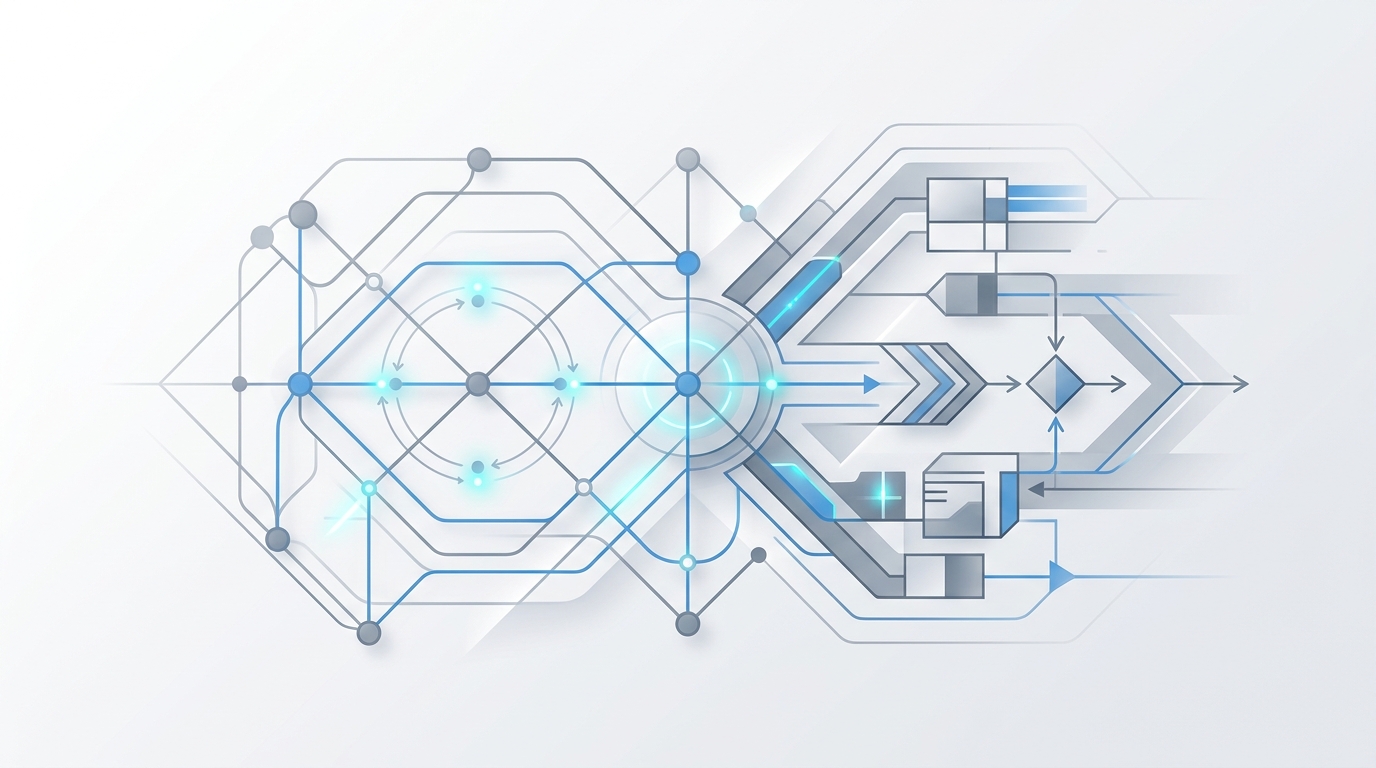
Ikona's WSM framework provides a structural lens for understanding where the demand siphon creates breakdowns, emphasizing the connective tissue that transforms individual AI investments into organizational capability.
Ikona's published WSM (Wiring, Sensors, Mechanisms) framework provides a structural lens for understanding exactly where the demand siphon creates breakdowns. WSM identifies three connective layers that determine whether an HR operating model can absorb and sustain new capabilities like AI:
Wiring refers to the connections between systems, teams, and processes: how information flows, who talks to whom, and where handoffs occur. The demand siphon degrades wiring by funding new AI tools without funding the integrations, data pipelines, and cross-functional workflows those tools require.
Sensors are the feedback mechanisms that tell the organization whether something is working: metrics, monitoring, escalation paths, and review cadences. Without sensors, an AI pilot can run for months before anyone realizes it is producing unreliable outputs. Governance gaps are, at their core, sensor failures.
Mechanisms are the operational structures that translate insight into action: decision rights, escalation protocols, and accountability frameworks. An AI recommendation without a mechanism to act on it is noise.
Most organizations that experience the demand siphon have invested in new capabilities (AI tools) without investing in the wiring, sensors, and mechanisms those capabilities depend on. The result is predictable: impressive components that do not connect into a functioning system.
The vitamins your organization needs to take consistently, the ones the demand siphon keeps deferring, are almost always wiring, sensors, and mechanisms. They are the connective tissue that transforms individual AI investments into organizational capability.
If you recognize the demand siphon in your organization, the first question worth answering is whether your current AI investments have the foundation to scale. Ikona's ISD methodology evaluates readiness across technology, process, data, and capability dimensions through 44-64 structured interviews, delivering a full diagnostic in under 90 days. We'd welcome the conversation. Request an ISD Lite assessment: a four-week structured diagnostic that identifies whether your AI investments have the foundation to compound.
Q: How long does it take to diagnose AI readiness gaps in HR?
Ikona's ISD Lite engagement produces a targeted business case and roadmap in four weeks from approximately 20 structured interviews focused on a single domain. A full ISD engagement, covering 44-64 interviews across the HR organization, delivers a complete diagnostic including a systems-level heat map, prioritized transformation roadmap, and AI opportunity charter in under 90 days.
Q: Can we assess AI readiness without pausing active AI pilots?
Yes. The diagnostic runs in parallel with existing initiatives. In fact, active pilots provide valuable evidence for the assessment. The goal is not to stop AI work but to identify which foundational investments will raise the ceiling on the work already underway.
Q: What is the difference between AI readiness and digital transformation readiness?
AI readiness is a subset of transformation readiness with specific additional requirements around data quality, governance structures, and capability maturity for interpreting and acting on AI outputs. An organization can be digitally mature (strong systems, automated workflows) and still lack AI readiness if its data governance, validation processes, or workforce capabilities have not been evaluated against AI-specific demands.
Q: What foundational investments have the highest impact on AI performance in HR?
Based on our engagement data, data quality and process standardization are the two foundational layers most frequently identified as binding constraints. Governance structures rank third but carry disproportionate risk because governance failures create regulatory and legal exposure, not just operational inefficiency.
Sources
[1] McKinsey & Company. "The State of AI." https://www.mckinsey.com/capabilities/quantumblack/our-insights/the-state-of-ai
[2] MIT Sloan School of Management. "Why Companies That Wait to Adopt AI May Never Catch Up." https://mitsloan.mit.edu/ideas-made-to-matter/why-companies-that-wait-to-adopt-ai-may-never-catch-up
Gartner. (2024). "More Than Half of GenAI Use Cases Are Likely Stalled or Abandoned." https://www.gartner.com/en/newsroom/press-releases/2024-11-18-gartner-says-more-than-half-of-genai-use-cases-are-likely-stalled-or-abandoned
The Nobel Prize. (2017). Richard H. Thaler: Facts. https://www.nobelprize.org/prizes/economic-sciences/2017/thaler/facts/
European Union. EU Artificial Intelligence Act. https://artificialintelligenceact.eu/
U.S. Equal Employment Opportunity Commission. (2023). "Select Issues: Assessing Adverse Impact in Software, Algorithms, and Artificial Intelligence." https://www.eeoc.gov/laws/guidance/select-issues-assessing-adverse-impact-software-algorithms-and-artificial
ISD (Ikona Systems Diagnostic) and WSM (Wiring, Sensors, Mechanisms) are proprietary frameworks developed by Ikona Analytics, grounded in practitioner experience across 30+ HR diagnostic engagements with Fortune 500 and large enterprise organizations.
Written by
Richard Rosenow
Richard Rosenow is Co-Founder and Chief Product Officer of Ikona Analytics, where he owns the ISD (Ikona Systems Diagnostic) methodology, client delivery, and product. He started as an HR business partner at Citi and spent 15 years in People Analytics at GE, Meta, Uber, Nike, and Argo AI, then as VP of People Analytics Strategy at One Model. He created the Workforce Systems Leader and People Data Supply Chain frameworks, and is an HR Tech 100 honoree.
Learn more about our team